01Current
Selection loop
Choose a canvas object, then commit one of the model-ranked actions proposed for it.
 Wega Labs
October by Wega Labs
Bring agents, computers, machines, and outputs onto one canvas. Direct them through voice, Omi, eye tracking, gestures, model-ranked selection—and eventually attention itself.
Why October first / 01
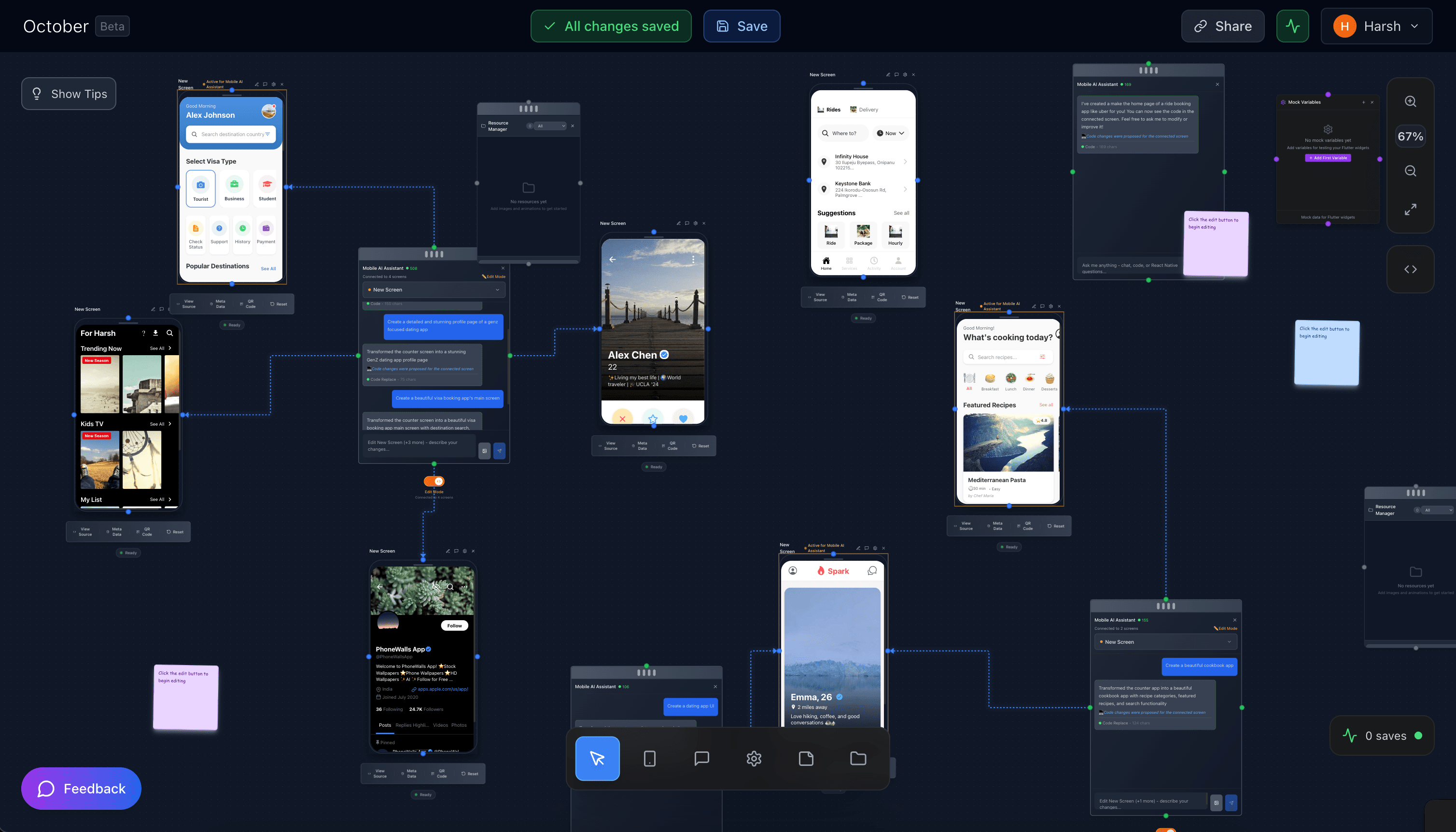
October already renders agents, screens, terminals, tasks, repositories, and outputs as persistent objects in space. The canvas gives every person and modality the same things to address.
Otto voice control ships today. Omi can extend voice across the room. Eye tracking can focus an agent. Hand gestures can move through the workspace. Model-ranked selection and attention research reduce how much the operator has to say or do.
Wega Labs is the lab. October is the product. Every modality is being built to control this canvas.
Interface programme / 02
Choose a canvas object, then commit one of the model-ranked actions proposed for it.
Drive each October object with a distinct modulation code and measure when its glow reaches the eye.
Attend to an agent or screen, decode the referent at Oz, then select and commit the action.
System model / 03
The human defines objectives, assigns responsibility, sets boundaries, observes execution, and accepts results.
A shared protocol provides peer discovery, messages, task ownership, canvas context, and execution status.
Agent runtimes work in isolated repositories and expose terminals, diffs, services, and previews to the control plane.
Models, providers, editors, and agent runtimes remain independent. October coordinates them through a common human control plane and agent protocol.
Coordination protocol / 04
The october-bus exposes peer discovery, messaging, relevant canvas state, task ownership, and execution status through MCP. It gives agents a shared operational context without granting unrestricted access to one another.
Screen A
Backend
Tests
discover peers · inspect canvas · message agents · report status · preserve provenance
System status / 05
Built + shipping
Current desktopAgent roster
Local harnessesAll listed agents can run locally. Their october-bus integrations are not equivalent.
In development
Use Omi and other wearable hardware to direct the canvas while moving between machines or working with both hands.
Look at an agent to focus it, then use a gesture or model-ranked selection to choose the action.
Resolve a canvas object through visual attention without requiring speech, typing, or visible movement.
Expose local agents, remote agents, and connected machines through the same control and coordination layer.
Human supervision / 06
Agents, tasks, terminals, services, and output remain visible in one workspace.
Each task has an assigned agent, bounded scope, dependencies, and reported status.
Git worktrees separate concurrent sessions before changes are reviewed and merged.
The system records which agent performed work, which files changed, and where output was produced.
Supervised execution cycle / 07
The human selects repositories, objectives, constraints, and approval boundaries.
Tasks are assigned to named agents with visible ownership and dependencies.
Agents exchange relevant context and status while executing in isolated workspaces.
The human inspects previews, diffs, tests, terminals, and provenance before acceptance.
Relationship to the interface research / 08
A linear chat hides the cost of addressing because there is only one thing being discussed. Put twenty live agents, computers, and machines on a canvas and the cost becomes obvious: much of what an operator types is simply identifying the right object.
Otto voice control already removes the hands from that loop. Omi, eye tracking, gestures, and attention provide other ways to identify and direct the same objects when speech, typing, or sitting at a desk does not fit the environment.
These are not premium input features. Together, they make October the human interface layer for complex agent and machine operations.
Why a canvas / 09
Every selectable object can carry its own modulation code. A code only means something if the workspace has distinct objects to attach it to. A chat log does not.
c-VEP resolves which of a handful of modulated objects is being attended to — too coarse for a toolbar button, comfortably precise for a screen block.
A canvas supports a known set of operations, so a model can propose the right few. That turns the problem from authoring language into choosing among candidates.
Blocks keep their identity across a session, so a resolved target stays valid long enough for a second selection to carry the instruction.
The canvas was built to supervise agents. It turned out to be the precondition for controlling them without a keyboard.
Current form factor / 10
A persistent canvas lets humans and agents refer to the same screen, task, position, and local context. The research above it changes how a human addresses that canvas, not what the canvas is.

October by Wega Labs
The desktop application ships today with a spatial canvas, live previews, terminals, isolated worktrees, and Otto voice control. Wega Labs' work on Omi, eye tracking, gestures, selection, and attention expands how people can control it.